Rare CS2 skins: Collections and patterns
 •
Rare CS2 skins: Retired collections, Howl, and exceptional patterns
You spot a skin that would fit your setup perfectly. You research its origin and discover that the collection is retired. Then you find a trade-up explanation showing how the same item can still be created. Has someone confused the facts? Not necessarily. The end of direct drops does not always mean the end of new examples.
Rare CS2 skins require a closer look than checking a rarity color and a collection's age. This guide explains the differences between a discontinued source, limited listings, and an unusual individual pattern. We will also examine Howl, Dragon Lore, and Souvenirs. Near the end, we will explain why finding only one listing is not enough to establish exceptional rarity.
What actually makes a skin rare?
Rarity grades are not population counts
Consumer Grade, Mil-Spec, Classified, and Covert are in-game item categories. On their own, they do not tell you how many examples of a finish exist or how many are available to buy.
A popular Covert skin may appear in many inventories. A lower-grade item may be harder to find in a particular variant. However, you cannot automatically assume every old blue-grade skin is scarcer than a newer red-grade one.
Existence and market availability are different
A skin on an inactive account still exists. Its owner may not offer it for sale, but that does not mean the item has been destroyed.
Distinguish the existing population, the items available for trading, and current sale listings. Item databases can also be incomplete. Their results should be described as recorded examples rather than a complete census of the game.
Rarity can concern a combination of characteristics
Sometimes a finish is available, but a particular seed, low float, and variant are difficult to find together. That differs from an item whose normal creation methods have ended entirely.
A comparison of the “rarest” therefore needs a criterion. Comparing every example of one finish with a narrowly defined pattern-and-wear combination of another can be misleading.
Does a retired collection have a closed supply?
The end of direct drops does not end every route
A source being retired may mean you can no longer obtain an item through a particular reward system. Existing containers or suitable trade-up inputs may still provide ways to create it.
Check every applicable creation method before describing supply as closed. This also applies to collections associated with completed Operations.
A map name does not explain acquisition rules
A collection named after a map does not automatically mean ordinary drops require playing that map. Drop systems, Operation rewards, and Souvenir Packages need separate explanations.
Removing a map from the competitive pool is not sufficient evidence that every item in its associated collection has stopped being created.
A case's age does not determine its status
It is inaccurate to label every old case as discontinued. Equally, an Operation association does not establish whether new containers can still be obtained.
Check the specific case against current information. Ending one distribution method and reducing its frequency are different situations.
How do containers and contracts change item populations?
Opening consumes a container and creates its contents
Opening an existing case removes that container and gives an item from its available contents. Stored containers can therefore continue producing skins after their original distribution ends.
A declining number of unopened cases does not mean the finishes inside them are simultaneously declining in number. Their availability and prices need separate assessment.
A contract consumes inputs but produces an output
Standard contracts using ten eligible skins consume those inputs and create a higher-grade item under the contract's rules. This can allow certain skins from older collections to keep appearing.
It is also incorrect to say every contract requires ten items. The October 22, 2025 update introduced exchanges of five Covert items for eligible knives or gloves, with separate rules for StatTrak.
Not every old skin is an eligible result
Contract availability depends on the particular item and eligible inputs. It does not mean any finish can be recreated.
Before purchasing inputs, check the rules, possible outcomes, and relevant item characteristics. An expensive contract is not automatically a sensible way to obtain the skin you want.
Examples of different kinds of scarcity
Compare the source and variant, not just the name
This table illustrates different availability mechanisms. It is not a ranking by population.
| Example | What distinguishes it? | Can new examples be created? | What should you check? |
| M4A4 Howl | Its removal history and Contraband classification | No standard route for creating new examples | Regular or StatTrak variant, wear, float, and stickers |
| Regular AWP Dragon Lore | A finish from the Cobblestone Collection | Yes, through a suitable trade-up contract | Variant, eligible inputs, and output conditions |
| Souvenir AWP Dragon Lore from historical Cobblestone packages | Association with historical tournament packages | Existing eligible packages can still produce it | Event, condition, and retained stickers |
| AK-47 Case Hardened with a desirable blue pattern | Scarcity of a particular appearance rather than the whole finish | Yes, while applicable acquisition methods remain available for that variant | Model, seed, float, and variant |
Why Dragon Lore variants need separate treatment
Dragon Lore features a distinctive dragon illustration and belongs to the Cobblestone Collection. Its recognition does not mean every example has the same origin.
A regular version can be produced through a suitable contract. A historical Souvenir example requires separate consideration of its event and stickers. They should not be valued as one interchangeable product simply because they share a finish name.
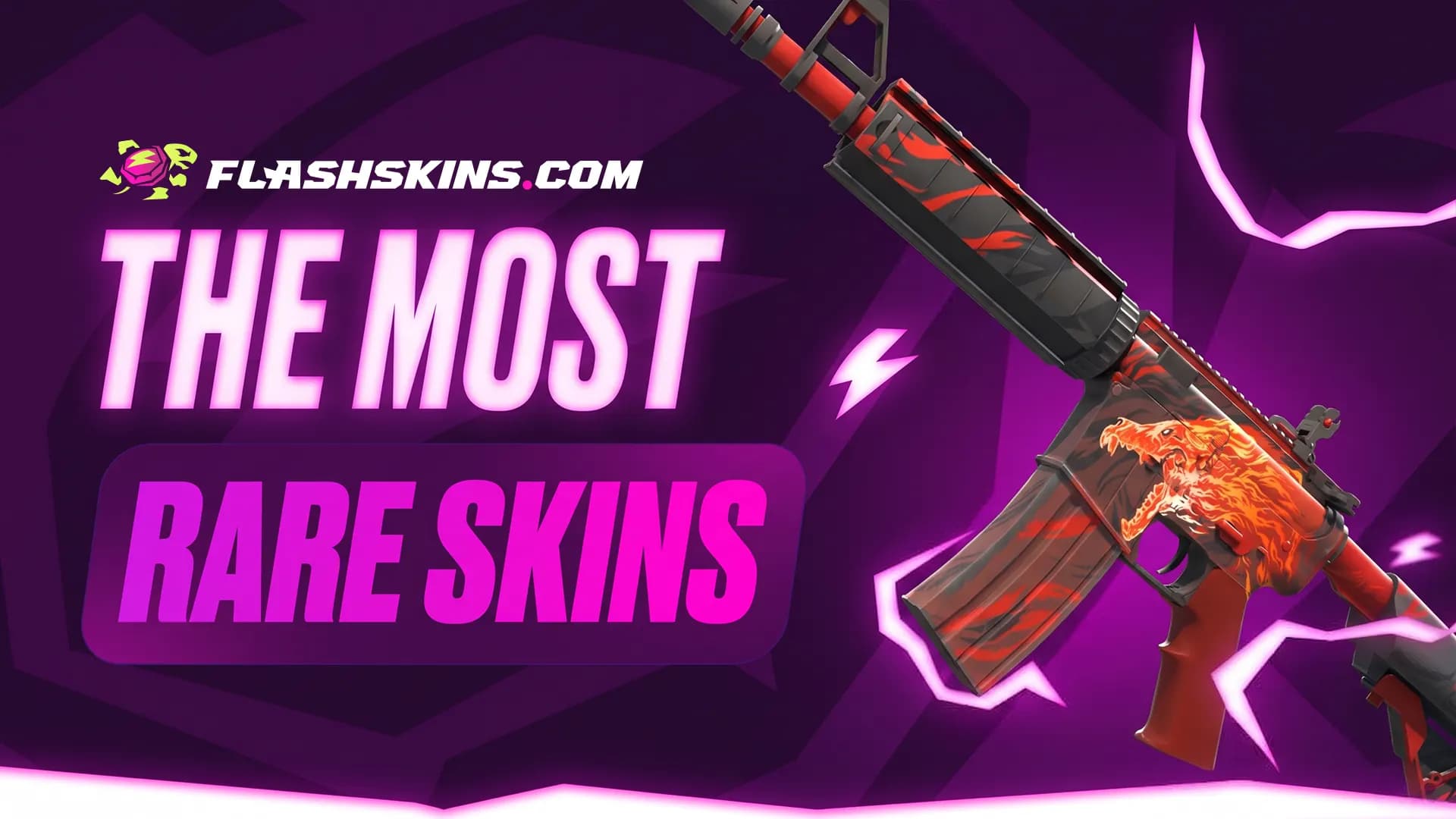
M4A4 Howl: An unusual case of removed content
What happened in 2014?
The Huntsman Case arrived on May 1, 2014. Valve published its copyright notice concerning Howl and Howling Dawn on June 11, roughly six weeks later.
Valve replaced the existing items' artwork with its own designs and assigned the Contraband classification. The relevant containers were also revised. Today's Howl retains a striking howling-wolf motif and red-orange color scheme.
Why an old case cannot give you Howl
Howl does not work like an ordinary item still available through stored containers. Buying an old Huntsman Case does not restore its previous contents.
You cannot obtain a new Howl by opening a Huntsman Case or completing a standard trade-up contract. That separates it from skins whose direct reward source ended but which can still be created another way.
It does not mean we know the complete population or that every existing example is currently available for trading.
Souvenirs: Event history and package availability
Acquisition systems have changed over time
Older distribution systems should not be presented as the rules for every Major. The system described by Steam uses a Viewer Pass and redemptions for packages associated with completed matches.
Redemption deadlines are set for the event. The end of the final does not automatically mark the end of that period.
A package can be opened years later
Existing packages can produce additional examples of their contents after a tournament ends. At the same time, the number of unopened packages decreases.
When collecting, check the specific event, possible contents, and individual item characteristics. Do not assume every older Souvenir is scarcer or more expensive than every newer one.
Rare patterns: When does the individual example matter?
Case Hardened and blue coverage
Case Hardened combines blue, gold, and purple areas. Their arrangement depends on the pattern, and collectors particularly value some layouts with substantial blue coverage.
That is a characteristic of the individual example, not a new rarity grade on its item label. The same seed can appear more than once.
A seed is not a unique serial number
A pattern number must be considered alongside the model and finish. The same number does not produce an identical effect or equal collector interest across different weapons and knives.
For Doppler, also check the phase or variant. For other finishes, examine the characteristics that actually influence their appearance. A seed number cannot replace inspecting the item.
An unusual pattern does not guarantee a premium
What matters is whether buyers want that particular layout. Not every uncommon-looking pattern has an established collector premium.
From an expert valuation perspective, comparable examples are essential. Ordinary finish prices are insufficient for assessing an exceptional pattern, but a seller's “rare pattern” description does not justify any asking price either.
How should you find rare skins and assess offers?
Check the item before buying
- Establish the exact weapon and finish name.
- Verify its variant, wear, float, and collection.
- Check the seed and other relevant characteristics where pattern differences matter.
- Inspect the individual example through an available preview.
- For a Souvenir, examine event information and stickers.
- Compare genuinely similar listings and reliable completed-sale information where available.
- Check transfer availability and the final transaction cost.
Limited comparisons reduce valuation confidence
An unusual item may not have three comparable listings or recent transactions. That is a limitation in the evidence, not proof that any high price is justified.
You can wait for more information, but waiting does not guarantee a cheaper purchase. Base the decision on your budget and what the individual example is worth to you.
Explore available items on FlashSkins
On FlashSkins, you can browse skin offers for your collection. Check the specific item's characteristics rather than assuming a desired pattern is available from the finish name alone.
Our guide to valuing, buying, and selling CS2 skins covers the broader comparison process. For exceptional items, an asking price is not automatically a confirmed selling value.
Does scarcity mean a high price?
Buyer interest still matters
A limited population can matter, but without buyer interest it does not ensure a high price or quick sale.
Do not assume current acquisition rules will remain unchanged forever. Assess the item using available information rather than promises of future appreciation.
Our take
We would look for history and appearance we enjoy
We would not begin with the most expensive item carrying a “rare” label. First, we would choose a weapon we enjoy using, then investigate interesting finishes, their origins, and the examples available.
An older, less obvious finish can be a great playskin even without a documented collector premium. We would pay extra for a particular pattern only after understanding its characteristics and appreciating the difference in-game.
FAQ: Rare CS2 skins
What determines a skin's rarity?
Relevant factors include its existing population, whether new examples can be created, and the characteristics of a particular variant. Listing counts are only part of the picture.
Does every retired skin have a closed supply?
No. It may still be created through existing containers or suitable trade-up contracts.
Can an old case produce a new skin?
Yes, if the item is part of its current contents. A container's age does not restore removed rewards.
Can you unbox M4A4 Howl?
No. It is no longer in the Huntsman Case contents and is not available as a standard contract output.
Can Dragon Lore still be created?
Yes. The regular version can be produced through a suitable contract, while eligible existing Cobblestone packages can produce a Souvenir version.
Does an inactive account reduce the number of skins?
No. Its items still exist, although they may be unavailable on the market.
Do trade-ups only reduce supply?
They consume inputs but create an output. Their effect on a particular skin depends on its role in the contract.
Is every blue Case Hardened a valuable Blue Gem?
No. Model, blue coverage, seed, and buyer interest all matter.
Is a rarer skin always more expensive?
No. Price also depends on demand, appearance, variant, and available offers.
Does one listing mean only one example exists?
No. Other examples may be in private inventories, unlisted, or absent from the database you are using.
Assess rare CS2 skins through their actual characteristics
Check the source, variant, and availability
Rare CS2 skins do not form one simple category. Howl, a historical Souvenir, and a desirable pattern can be exceptional for entirely different reasons.
Here is the trap introduced at the beginning: one available listing does not mean one existing example. Equally, the end of direct drops does not prove that new skins can no longer be created.
Explore FlashSkins offers, inspect individual items, and compare their characteristics. Build your collection around the history and appearance you value rather than a rarity claim alone.

I am a veteran player with over 20 years of experience, having been part of the Counter-Strike community since the early days of 1.6. As an expert in virtual economy and gameplay mechanics, I help you reach the next level by creating technical guides and tactical breakdowns, while providing data-driven insights into the CS2 skin market and sticker investments.